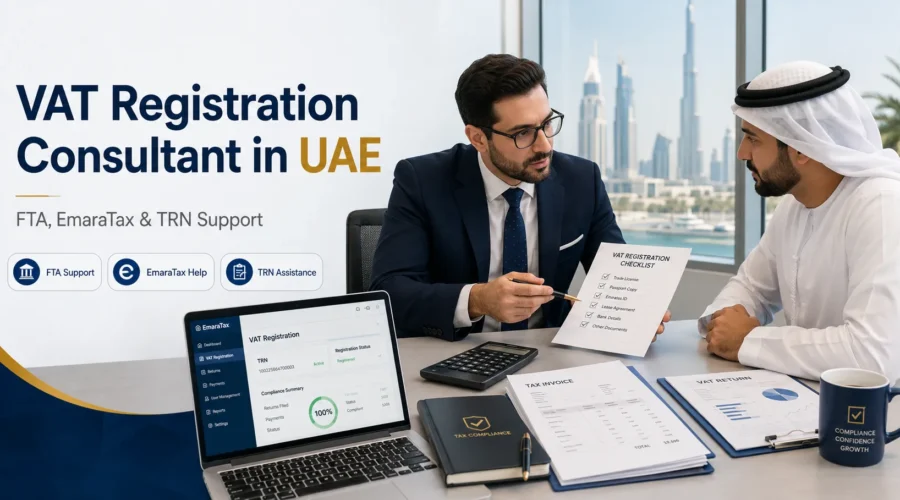
VAT Registration Consultant in UAE for FTA, EmaraTax & TRN Support
Need VAT registration in UAE?
Our VAT registration consultants help businesses check eligibility, prepare documents, submit applications through EmaraTax, handle FTA queries, receive TRN, set up VAT-compliant invoices, and prepare for first VAT return filing.
We support mainland, free zone, ecommerce, consultancy, trading, real estate, construction, medical, restaurant, and service businesses across the UAE.
A VAT Registration Consultant in UAE helps businesses complete VAT registration through the Federal Tax Authority, manage EmaraTax submission, and receive a valid TRN for compliant tax invoicing and VAT filing. Businesses in the UAE may need VAT registration when their taxable supplies and imports reach the required threshold, so a consultant reviews eligibility, prepares documents, submits the VAT application, responds to FTA queries, and guides the business after TRN approval. Expert VAT registration support is useful for mainland companies, free zone businesses, startups, freelancers, ecommerce sellers, trading companies, and service providers. After registration, businesses must issue VAT-compliant invoices, track input VAT and output VAT, maintain proper records, and file VAT returns on time. Working with a VAT Registration Consultant in UAE reduces mistakes, avoids delays, supports FTA compliance, and helps businesses start their VAT journey with confidence.
What Does a VAT Registration Consultant in UAE Do?
A lot of businesses think VAT registration is just filling in a form.
It is not.
The FTA application requires a correct EmaraTax profile, the right business activity classification, proper turnover proof, consistent documents, and the ability to respond to FTA queries quickly. A missing document or a small mismatch can delay your TRN by weeks.
A VAT registration consultant in UAE helps you:
- Check whether your business must register or qualifies to register voluntarily
- Review your taxable supplies, imports, and revenue records before applying
- Confirm whether you need mandatory or voluntary registration
- Prepare and organise all required documents before touching EmaraTax
- Submit the VAT registration application correctly the first time
- Handle any FTA clarification requests with proper documentation
- Follow up until your TRN is issued
- Set up your VAT invoice template
- Plan your first VAT return
- Create a VAT filing calendar based on your assigned tax period
- Guide your accounting and record keeping so you are ready for audit
Direct answer:
A VAT registration consultant in UAE helps businesses register for VAT through EmaraTax, prepare required documents, respond to FTA queries, receive TRN, set up VAT invoices, and organise records for future VAT return filing.
For a list of verified VAT consultants in UAE, you can explore category listings to compare firms by location and service type.
Who Needs VAT Registration in UAE?
Not every business in the UAE needs to register for VAT right now. But more businesses qualify than most people realise.
Mandatory VAT Registration
You must register when your taxable supplies and imports exceed AED 375,000 in the past 12 months — or when you expect them to exceed that amount in the next 30 days.
“Taxable supplies” includes:
- Standard-rated sales (5% VAT)
- Zero-rated sales (exports, international transport, etc.)
- Any goods or services you supply in the UAE that are not exempt
It does not include exempt supplies like residential rent or financial services.
Voluntary VAT Registration
You can register voluntarily if your taxable supplies, taxable imports, or taxable expenses exceed AED 187,500 — even if you have not hit the mandatory threshold.
Why voluntarily register?
- Recover input VAT on business costs, equipment, and professional fees
- Issue proper tax invoices to B2B clients who need them for their own input VAT recovery
- Build credibility with corporate and government clients
- Prepare your business before you cross the mandatory threshold
Non-Resident VAT Registration
A foreign business with no UAE establishment may still need VAT registration if it makes taxable supplies in the UAE and there is no UAE-registered person responsible for accounting for that VAT.
Who this commonly affects:
- Overseas software and SaaS providers with UAE customers
- Foreign consultants running events or delivering services in the UAE
- Non-resident ecommerce businesses shipping to UAE buyers
Non-resident registration has different documentation requirements. A consultant familiar with the FTA’s requirements is strongly recommended.
VAT Registration Threshold in UAE
| Registration Type | Threshold | Who It Applies To | Key Advice |
|---|---|---|---|
| Mandatory VAT Registration | AED 375,000+ | Businesses whose taxable supplies and imports cross this limit in 12 months or expected 30 days | Apply on time — late registration carries penalties |
| Voluntary VAT Registration | AED 187,500+ | Startups and SMEs with taxable supplies, imports, or expenses above this level | Useful if you have recoverable input VAT or B2B invoicing needs |
| Non-Resident Registration | Case-by-case | Foreign businesses making taxable supplies in the UAE | Review business activity and supply location before applying |
When does the 12-month window start?
The review is a rolling 12 months — not a calendar year. So if you are checking in October, you look back at November of the previous year through October of the current year. Many businesses miss this and think they are safe because their annual accounts show figures below the threshold.
Expert observation:
Review your taxable revenue every single month. A lot of UAE SMEs wait until the last moment to check. Then they spend a week scrambling for invoices, bank records, and expense documentation when the EmaraTax application is already open. Monthly monitoring takes 10 minutes. Late registration takes much longer to fix — and costs money.
VAT Registration Process Through EmaraTax
EmaraTax is the FTA’s online portal for all tax obligations. VAT registration, return filing, payment, amendments, and correspondence all happen here.
Step-by-Step VAT Registration Process in UAE
Step 1: Go to the EmaraTax portal (tax.gov.ae) and create your account using a valid email and UAE phone number.
Step 2: Create a Taxable Person profile. If you are registering on behalf of a company, link the trade license here.
Step 3: Select “VAT Registration” from the available registration types.
Step 4: Add trade license details — license number, issuing authority, expiry date, legal name, and business address.
Step 5: Add owner and authorised signatory details — passport number, Emirates ID, nationality, and role.
Step 6: Add business activity details and turnover figures — past 12-month revenue and expected next 12-month figures.
Step 7: Upload all required documents clearly and completely.
Step 8: Review every section before submitting — check for typos, number mismatches, and missing fields.
Step 9: Submit the application. You will receive a reference number — save it.
Step 10: If the FTA sends a clarification request, respond within the given deadline with the requested documents.
Step 11: Receive your TRN after FTA approval. Download your VAT certificate from EmaraTax.
Common EmaraTax Mistakes That Delay Applications
| Mistake | What Goes Wrong |
|---|---|
| Wrong business activity | FTA may query or reject the registration category |
| Wrong turnover amount | Mismatch with bank records or invoices triggers clarification |
| Missing revenue documents | Application put on hold pending resubmission |
| Expired trade license | Application rejected outright |
| Incorrect contact information | FTA queries go unanswered, causing further delay |
| Unclear bank details | Verification issues |
| Wrong registration type | Confusion between mandatory and voluntary |
| Ignoring FTA clarification | Application expires or is rejected |
| Uploading blurry documents | FTA cannot verify — requests resubmission |
| Duplicate taxable person profile | System errors and application linking issues |
Before you submit:
Match your trade license details, bank account name, owner’s passport details, invoices, and turnover figures. A single mismatch between what is on your license and what is on your bank account can send your application back.
Documents Required for VAT Registration in UAE
Get these ready before opening EmaraTax. Applying without a complete document set is the most common reason for delays.
Core documents:
- Valid trade license (not expired)
- Passport copies of all owners and partners
- Emirates ID of owners and authorised signatory
- Memorandum of Association (for LLCs and partnerships)
- Business address details and tenancy contract if required
- Bank account details (account name must match trade license name)
- Authorised signatory details
Revenue and turnover proof:
- Sales invoices covering the past 12 months
- Purchase and expense invoices
- Bank statements showing business revenue
- Expected turnover supporting documents
- Import/export documents (if applicable)
- Customs registration details (if applicable)
For voluntary registration:
- Proof of taxable supplies above AED 187,500, OR
- Proof of taxable expenses above AED 187,500
What a Consultant Does During Document Review
A VAT registration consultant does not just collect documents. They check:
- Whether your trade license is valid and active
- Whether the business name on your bank account matches your license
- Whether your invoices clearly show taxable supplies in the UAE
- Whether your revenue figures are consistent across documents
- Whether your activity classification matches your actual business
- Whether voluntary registration grounds are clearly evidenced
- Whether any documents are missing or need updating before submission
A 30-minute document review by a consultant before submission is worth far more than a 4-week delay while the FTA waits for resubmitted documents.
VAT TRN and VAT Registration Number in UAE
What is TRN?
TRN stands for Tax Registration Number.
The FTA issues it after your VAT registration is approved. It is a 15-digit number unique to your business as a VAT-registered entity in the UAE.
Where your TRN is used:
- Every tax invoice you issue — mandatory
- Every VAT return you submit
- FTA correspondence and portal communications
- Supplier and customer TRN verification
- Your VAT certificate (downloadable from EmaraTax)
- Accounting records and VAT ledger
VAT TRN Verification in UAE
Businesses should verify their suppliers’ TRN before accepting tax invoices and claiming input VAT on them.
Why it matters:
- If you claim input VAT based on an invoice from an unregistered supplier, you are making an incorrect claim
- The FTA can disallow those input VAT claims during an audit
- You end up paying back VAT you thought you had already recovered
How to verify:
Use the FTA’s TRN verification tool on tax.gov.ae. Enter the TRN from the supplier’s invoice and confirm it matches the registered business name.
Do this for all new suppliers. It takes under a minute.
Common TRN Mistakes UAE Businesses Make
- Putting a wrong TRN on invoices (even a single digit error)
- Missing TRN entirely on tax invoices — very common in the first weeks after registration
- Accepting supplier invoices with no TRN and still claiming input VAT
- Not downloading the VAT certificate after registration
- Confusing the trade license number with the TRN
- Using a TRN from a group company or related entity on the wrong entity’s invoices
VAT Registration for Free Zone Companies in UAE
The Big Misconception
Free zone companies in the UAE often believe their license automatically protects them from VAT obligations.
It does not.
VAT registration for a free zone company depends on:
- Whether the company makes taxable supplies to UAE mainland customers
- Whether the company imports goods into the UAE
- Whether the company exports — and whether proper documentation exists
- The specific free zone and whether it qualifies as a “designated zone” under UAE VAT law
- Where customers are physically located
Designated Zones — What Changes
Certain free zones are classified as “designated zones” by the UAE Cabinet. Goods moving between designated zones, or from a designated zone to outside the UAE, can have special VAT treatment.
But this only applies to goods. Services from a designated zone to a UAE customer are generally standard-rated at 5%.
Free Zones in UAE Where VAT Can Apply
- DMCC (Dubai Multi Commodities Centre)
- JAFZA (Jebel Ali Free Zone)
- DAFZA (Dubai Airport Free Zone Authority)
- Dubai South
- IFZA (International Free Zone Authority)
- Meydan Free Zone
- RAKEZ (Ras Al Khaimah Economic Zone)
- SHAMS (Sharjah Media City)
- ADGM (Abu Dhabi Global Market)
- DIFC (Dubai International Financial Centre)
Free Zone VAT Mistakes
| Mistake | Risk |
|---|---|
| Assuming free zone = no VAT | Late registration penalty + unpaid VAT liability |
| Not tracking UAE mainland customer sales | Wrong zero-rating on taxable supplies |
| Not separating export and local sales | Overclaiming zero-rating |
| Ignoring imports | Missing reverse charge or customs VAT obligations |
| Not checking designated zone rules | Incorrect treatment of goods movements |
| Missing VAT invoice requirements | Audit exposure and input VAT disputes with clients |
VAT Registration for Mainland Companies in UAE
Mainland companies — regardless of size, sector, or legal structure — are fully within the UAE VAT system once they cross the relevant threshold.
Business types that commonly need VAT registration attention:
- LLC companies — multiple partners, potentially complex revenue, intercompany transactions
- Sole establishments — often operated by expats, can cross threshold without structured invoicing
- Branch offices — need clarity on how head office cross-charges are treated
- Professional license businesses — consultants, engineers, lawyers, architects
- Service companies — UAE and overseas clients may have different VAT treatment
- Trading companies — imports and exports create layered documentation needs
- Restaurants and cafes — daily POS sales must be tracked and reconciled against return figures
- Clinics and medical providers — exempt vs taxable services need clear separation
- Construction and contracting — progress billing and retention have specific VAT timing rules
- Real estate service businesses — commissions, management fees, and property types each carry different treatment
VAT Registration for Small Businesses, Startups, and Freelancers
Small Businesses
Small businesses often reach the mandatory threshold without a proper invoicing system in place. Common pattern: the business owner realises they crossed AED 375,000 only when closing the year-end accounts — months after the threshold was crossed.
Priorities for small business VAT registration:
- Review cumulative monthly revenue against the AED 375,000 threshold
- Set up a proper invoice numbering system from the start
- Understand which of your expenses carry recoverable input VAT
- Set a reminder 4 weeks before every filing deadline
- Keep sales invoices, purchase invoices, and bank records in one place
Startups
Startups with investor funding or heavy early setup costs should seriously consider voluntary VAT registration.
Why:
- You can recover input VAT on setup costs, professional fees, equipment, and office fit-out
- You can issue formal tax invoices to B2B clients — some corporate and government clients will not work with unregistered suppliers
- It establishes clean accounting from the start rather than fixing it later
What to prepare:
- Expected turnover projections with supporting basis
- Records of taxable expenses already incurred
- Business plan or investor deck confirming planned taxable activity
Freelancers
Freelancers with a UAE freelance permit or professional license need to monitor their taxable services.
VAT applies to freelancers when:
- Total taxable services to UAE clients cross AED 375,000 (mandatory)
- Or they qualify for voluntary registration at AED 187,500
Place of supply matters:
A freelancer invoicing an overseas client for services delivered remotely may qualify for zero-rating — but this requires evidence. The client’s location, the nature of the service, and the payment record all need to support the zero-rating claim.
VAT Registration for Ecommerce and Online Sellers
Ecommerce VAT in the UAE is more complicated than most sellers expect.
The FTA looks at your taxable supplies. That means every taxable sale to a UAE buyer — regardless of which channel it came through.
What counts as taxable supply for an ecommerce seller:
- Website orders delivered to UAE addresses
- Amazon.ae marketplace sales
- Noon.com marketplace sales
- Instagram and TikTok direct sales
- WhatsApp orders settled by bank transfer or cash on delivery
- Payment link sales via Stripe, PayTabs, Telr, or similar gateways
- Retail pop-up or event sales
What you need to track for VAT registration:
| Data Source | Why It Matters |
|---|---|
| Amazon.ae seller reports | Monthly taxable UAE revenue |
| Noon.com reports | Additional UAE sales channel |
| Website analytics + payment gateway | Direct sales to UAE buyers |
| Bank statements | Total deposits to reconcile against sales |
| Import documents | Customs VAT and reverse charge |
| Delivery records | Evidence of UAE delivery (confirms place of supply) |
What competitors miss:
Most guides tell ecommerce sellers to “track their sales.” But the real gap is consolidation. Sellers often have 4 to 6 different sales sources, each with a different report format, different currency, and different settlement cycle. A proper VAT registration review consolidates all of them before the application — so the turnover figure on EmaraTax is accurate and supportable.
VAT Registration for Industry-Specific Businesses
Consultancy Firms
Consultancy VAT depends on where your client is:
| Client Location | VAT Treatment |
|---|---|
| UAE mainland business or consumer | Standard 5% VAT |
| Outside UAE — services performed outside UAE | Zero-rated (with export evidence) |
| Outside UAE — services performed inside UAE | May still be 5% depending on place of supply rules |
Retainer agreements, project invoices, and milestone billing all need proper VAT treatment from the first invoice after registration.
Trading Companies
Trading businesses often have the most documentation to manage:
- Sales invoices must match customs export records for zero-rating
- Purchase invoices from UAE suppliers must show valid TRN
- Import documents must be reconciled against VAT return figures
- Reverse charge may apply on imported services from overseas suppliers
Real Estate Service Businesses
Real estate VAT is not simple. The same property can have different VAT treatment depending on its type, use, and transaction stage:
| Transaction | VAT Treatment |
|---|---|
| Commercial property sale | Standard 5% |
| First sale of residential property | Zero-rated |
| Subsequent sale of residential property | Exempt |
| Commercial rent | Standard 5% |
| Residential rent | Exempt |
| Brokerage commission | Standard 5% |
| Property management fee | Standard 5% |
Real estate businesses registering for VAT should also maintain contracts, payment schedules, DLD-related records, Oqood documents (for off-plan), title deed copies, and escrow payment confirmations. This is the documentation the FTA expects when reviewing real estate transactions.
Construction Companies
Construction VAT is complex because of billing structures:
- Progress billing: VAT applies at each billing stage
- Advance payments: VAT tax point may be triggered at payment receipt — not project completion
- Retention: VAT accounting must be correct at billing, not at release date
- Variations: Each variation order may need its own tax invoice
- Subcontractors: All subcontractor invoices must be VAT-compliant for input VAT claims
Restaurants and Clinics
Restaurants: POS reports are the key document. Daily or weekly sales totals must reconcile with the bank deposits and the VAT return figures. Supplier bills need TRN for input VAT claims.
Clinics: Some medical services are exempt (most healthcare services are zero-rated under UAE VAT law for qualifying services). Others — cosmetic procedures, non-essential services — may be standard-rated. The classification must be correct from the first VAT return.
VAT Registration Cost in UAE
The FTA does not charge a fee for VAT registration itself.
The cost you pay is for the consultant’s service.
| Business Type | Complexity | What Affects Cost | Recommended Support |
|---|---|---|---|
| New single-activity service company | Low to medium | License, turnover proof, invoices | Registration and invoice setup |
| Ecommerce seller | Medium to high | Multiple sales channels, import records | Registration plus sales consolidation |
| Import/export trading company | High | Customs records, supplier invoices, exports | Registration plus VAT advisory |
| Free zone company | Medium | Customer location, designated zone rules, supply type | Registration review and position paper |
| Voluntary registration applicant | Medium | Proof of qualifying expenses or supplies | Strong document preparation |
| Non-resident business | High | Place of supply analysis, overseas business structure | Full advisory and registration |
What honest consultants will tell you:
A straightforward mandatory registration for a single-activity mainland business with clean records and organised invoices is not expensive. A voluntary registration where the business needs to prove qualifying expenses through a messy set of documents spread across multiple bank accounts takes more work.
Get a quote based on your actual situation — not a blanket price from a website.
Why VAT Registration Gets Delayed or Rejected
This is the section competitors almost never cover properly. And it is one of the most searched topics by people who have already started their registration.
Most common reasons for VAT registration delay or rejection:
- Missing documents — the single biggest cause; most often missing revenue proof or ownership documents
- Expired trade license — the FTA will not process a registration linked to an expired license
- Wrong business activity on EmaraTax — does not match the trade license activity
- Wrong turnover amount — the figure entered does not match invoices or bank statements
- Unclear revenue records — bank deposits do not clearly match sales invoices
- No proof for voluntary registration — applicant claims voluntary eligibility but cannot provide clear documentation
- Owner details mismatch — passport number or name does not match Emirates ID
- Incomplete EmaraTax profile — sections skipped or left blank
- Wrong contact information — FTA sends clarification to an email that is no longer monitored
- FTA clarification not answered on time — application expires after the response deadline
- Duplicate taxable person profile — causes linking errors and processing blocks
- Uploaded documents unreadable — blurry, cropped, or password-protected files
What to do if your application is delayed:
- Log into EmaraTax and check for any FTA correspondence under your application
- Check the email linked to your EmaraTax account (including spam folder)
- Review the application reference for status updates
- Respond to any clarification request within the stated deadline
- If no clarification is showing but the application is stalled, call the FTA or submit a support request
Do not assume silence means approval. Check the portal every few days after submission.
What Happens After VAT Registration?
Most VAT registration guides end at “you receive your TRN.” That is the beginning, not the end.
Here is what needs to happen immediately after registration:
In the first week:
- Download your VAT certificate from EmaraTax
- Update all invoice templates to include your TRN
- Add “Tax Invoice” wording and a separate VAT amount line to every invoice
- Inform your regular customers that you are now VAT-registered
In the first month:
- Set up a VAT accounting ledger — track output VAT and input VAT separately
- Start collecting valid TRN invoices from all suppliers
- Build your VAT filing calendar based on your assigned tax period
- Begin reconciling sales against bank deposits monthly
Before your first VAT return:
- Reconcile all sales invoices against your accounting records
- Verify all input VAT claims have valid TRN invoices from suppliers
- Identify any zero-rated or exempt supplies and separate them
- Check for any reverse charge items on imported services
- Prepare the return at least one week before the deadline
Ongoing:
- Monitor EmaraTax for FTA notifications
- Keep records for the minimum retention period required by UAE tax law
- Review your VAT position if your business activity changes
- Conduct an annual compliance review
VAT Filing After Registration
After registration, your main recurring VAT obligation is filing VAT returns.
What a VAT return covers:
- Output VAT — VAT you charged on taxable sales during the period
- Input VAT — VAT you paid on eligible business purchases
- Net VAT payable — output VAT minus input VAT = what you owe the FTA
- Adjustments — credit notes, bad debt relief, corrections from prior periods
VAT return filing process:
- Collect all sales invoices for the period
- Collect all purchase and expense invoices with valid TRN
- Calculate output VAT — standard-rated, zero-rated, and exempt totals
- Calculate input VAT — only on eligible purchases with valid invoices
- Identify reverse charge items
- Prepare the return on EmaraTax
- Review figures before submitting
- Submit return
- Pay VAT payable by the deadline
- Save confirmation and payment receipt
Filing deadlines:
| Tax Period | Filing Deadline |
|---|---|
| Quarterly | 28 days after end of quarter |
| Monthly | 28 days after end of month |
Late filing penalty starts from day 29. It is not a grace period — it is a hard deadline.
DIY VAT Registration vs Hiring a Consultant
| Factor | DIY VAT Registration | VAT Registration Consultant |
|---|---|---|
| Eligibility review | You assess your own threshold | Consultant reviews threshold, activity, and history |
| Document accuracy | Higher risk of missing or mismatched items | Documents checked before submission |
| EmaraTax submission | You navigate the portal yourself | Consultant guides or manages the full process |
| FTA clarification | You respond alone, often without knowing what the FTA needs | Consultant prepares documented response |
| TRN follow-up | You track status manually | Consultant monitors and follows up |
| Invoice setup | Often forgotten or done incorrectly | VAT-compliant invoice template provided |
| First VAT return | Usually not planned ahead | Filing calendar and first return support included |
| Time investment | Significant, especially for complex businesses | Minimal — consultant handles the process |
| Risk of rejection | Higher for unclear records or wrong activity | Lower — pre-submission review reduces errors |
| Best for | Very simple, single-activity businesses with clean records | SMEs, free zones, ecommerce, import/export, complex cases |
Bottom line:
If you are a sole trader with one client type, a single bank account, clear invoices, and revenue clearly above the threshold — you can DIY.
If you have multiple revenue streams, marketplace sales, imports, a free zone license, overseas clients, unclear records, or are applying voluntarily — hire a consultant.
UAE Location Coverage
VAT Registration Consultant in Dubai
Dubai has the most diverse business mix in the UAE — from DMCC and JAFZA free zone companies to mainland LLCs in Business Bay, trading firms in Deira, and ecommerce sellers running operations from Al Quoz or Dubai Silicon Oasis.
Common issues in Dubai: free zone VAT assumptions, ecommerce multi-channel reporting, consultancy place of supply, real estate transaction documentation.
Explore accounting and VAT services in Dubai for firms operating in the city.
VAT Registration Consultant in Abu Dhabi
Abu Dhabi businesses often include large corporate offices, industrial companies, oil and gas support businesses, and professional service firms. Registration complexity here often involves intercompany transactions, government contract billing, and large import records.
VAT Registration Consultant in Sharjah
Sharjah has a strong base of trading companies, warehouses, manufacturers, and small businesses. Common issue: crossing the mandatory threshold through import activity without realising customs records count as taxable supplies.
VAT Registration Consultant in Ajman
Ajman SMEs, service firms, restaurants, and small trading companies frequently fall into the voluntary registration window. The question is whether voluntary registration makes sense for their business model.
VAT Registration Consultant in Ras Al Khaimah
RAKEZ is a major free zone in RAK. Companies in manufacturing, logistics, and trading need careful review of their designated zone status, import records, and UAE mainland customer sales before registration.
VAT Registration Consultant in Fujairah
Fujairah’s port-related economy means many businesses here deal with shipping, logistics, and trading — all with significant import/export records that must be carefully handled in the VAT registration application.
VAT Registration Consultant in Umm Al Quwain
Smaller business base but growing. SMEs and service providers here often need help with voluntary registration eligibility and first invoice setup.
Real UAE VAT Registration Case Examples
Case 1: Dubai Consultancy Firm — Threshold Crossed, No Invoice System
The problem: A management consultancy in Business Bay had been operating for 14 months. Revenue crossed AED 375,000 but the owner did not track it monthly. No TRN, no VAT invoices, no awareness of the registration obligation.
What was done: Reviewed the full revenue history by month. Identified the exact month the threshold was crossed. Calculated the number of days the business was late. Prepared documents, submitted the EmaraTax application, handled two FTA clarification queries about turnover proof, and received TRN within 3 weeks of submission.
After registration: Set up a VAT-compliant invoice template and created a quarterly filing calendar.
Result: Business became compliant with a clear record of corrective action. The late registration penalty was unavoidable but limited. The business avoided further exposure by registering before the FTA identified the gap.
Case 2: Sharjah Ecommerce Seller — Four Sales Channels, One Incomplete Application
The problem: An ecommerce seller had revenue from Amazon.ae, Noon.com, a Shopify website, and direct WhatsApp orders. The EmaraTax application only reflected Amazon sales. The submitted turnover figure was significantly lower than actual taxable supplies.
What was done: Collected all marketplace reports, Shopify payment gateway exports, WhatsApp order records, and bank statements. Built a consolidated monthly revenue sheet. Resubmitted the application with the correct turnover figure and supporting documents for all channels.
Result: The business registered with an accurate taxable supply figure. The VAT return setup correctly captured all four channels from the first filing period.
Case 3: Abu Dhabi Trading Company — Import Records Not Connected to Registration
The problem: A trading company imported goods regularly and had strong customs documentation. But when the owner started the EmaraTax application, they only counted UAE sales invoices — not the value of imports. The turnover figure was wrong, and the application was incomplete.
What was done: Reviewed all customs import documents, reconciled against purchase invoices, and explained how taxable imports count toward the registration threshold. Rebuilt the turnover calculation with imports included.
Result: The company understood its actual VAT position. The registration was submitted with the correct combined figure of taxable sales and imports. No FTA clarification was needed.
Case 4: Free Zone Company — Wrong Assumption About VAT Exemption
The problem: A DMCC-licensed company was selling services to UAE mainland businesses. The owner was certain that a DMCC license meant VAT did not apply.
What was done: Reviewed the company’s customer list — predominantly UAE mainland B2B clients. Reviewed service types — all standard-rated. Identified that the company had been issuing invoices for over a year without VAT and without TRN.
Result: The company registered for VAT, issued corrected invoices to clients where possible, understood the difference between free zone exemption myths and actual VAT law, and started filing quarterly returns.
Expert Checklist Before Hiring a VAT Registration Consultant
Use this before signing an engagement with any firm:
- [ ] Do they clearly understand EmaraTax and the FTA registration process?
- [ ] Can they explain mandatory vs voluntary registration in plain language?
- [ ] Will they review your documents before submitting — not after?
- [ ] Can they handle FTA clarification if it comes up?
- [ ] Do they explain TRN and how to use the VAT certificate?
- [ ] Do they help you set up your VAT invoice template?
- [ ] Do they prepare a plan for your first VAT return?
- [ ] Do they understand both mainland and free zone VAT rules?
- [ ] Can they support ecommerce, import/export, or industry-specific cases?
- [ ] Can you reach them via WhatsApp or direct phone when needed?
- [ ] Is their pricing transparent and confirmed before work starts?
- [ ] Do they offer post-registration compliance support?
If a consultant cannot answer these clearly, keep looking.
Why Choose Our VAT Registration Consultants in UAE
UAE-wide coverage:
We support businesses in Dubai, Abu Dhabi, Sharjah, Ajman, Ras Al Khaimah, Fujairah, and Umm Al Quwain — not just one emirate.
FTA and EmaraTax process knowledge:
We know the portal, the FTA’s documentation expectations, and how to respond to clarification requests properly.
Document review before submission:
We check everything before it goes to the FTA. That means fewer delays, fewer queries, and faster TRN receipt.
TRN application follow-up:
We track your application status and follow up until your TRN is issued. You do not chase the FTA — we do.
Support for every business type:
Mainland, free zone, ecommerce, trading, consultancy, real estate, construction, restaurant, clinic, startup, freelancer — we have handled them all.
First VAT return support:
Registration is step one. We help you set up the invoice template, build the filing calendar, and plan the first return. So you are not starting from zero when the first deadline arrives.
Penalty prevention approach:
We apply early. We apply correctly. We track the deadlines. That is how we keep businesses out of the FTA’s late registration penalty list.
Direct communication:
WhatsApp and phone access to your consultant. Not a ticketing system.
For firms with listed profiles and client reviews, Yellow Pages UAE (yellowpagesae.com) provides a useful reference for comparing VAT registration consultants and accounting firms across the UAE by location and specialty.
FAQs
What is a VAT registration consultant in UAE?
A VAT registration consultant in UAE helps businesses check VAT eligibility, prepare documents, submit VAT registration through EmaraTax, respond to FTA queries, receive TRN, and set up VAT records for future return filing.
Who needs VAT registration in UAE?
A business needs VAT registration in UAE when its taxable supplies and imports meet or are expected to meet the mandatory threshold of AED 375,000. Businesses with taxable activity above AED 187,500 may apply voluntarily.
Can I register for VAT online in UAE?
Yes. VAT registration in the UAE is completed online through the FTA’s EmaraTax platform at tax.gov.ae. Businesses can apply directly or hire a VAT consultant to prepare documents and manage the submission.
What is TRN in UAE?
TRN means Tax Registration Number. It is a 15-digit number issued by the FTA after successful VAT registration. It is required on all tax invoices, VAT returns, and official FTA records.
What happens after VAT registration?
After VAT registration, the business receives a TRN, updates all invoices with the TRN and VAT amount lines, tracks input and output VAT, follows the assigned filing calendar, and submits VAT returns by their due dates.
What is VAT registration in UAE?
VAT registration is the process of formally enrolling your business in the UAE’s Value Added Tax system through the FTA’s EmaraTax portal. Once registered, you receive a TRN and must collect, report, and pay VAT on taxable supplies.
What does a VAT registration consultant in UAE do?
They check your VAT eligibility, prepare documents, submit your EmaraTax application, handle FTA queries, follow up until your TRN is issued, set up your invoice template, and plan your first VAT return.
Who needs VAT registration in UAE?
Any business with taxable supplies and imports above AED 375,000 in 12 months must register. Businesses above AED 187,500 may apply voluntarily.
What is the VAT registration threshold in UAE?
Mandatory: AED 375,000. Voluntary: AED 187,500 in taxable supplies, imports, or expenses.
What is voluntary VAT registration in UAE?
It allows businesses below the mandatory threshold to register if their taxable activity or expenses exceed AED 187,500. Benefits include input VAT recovery and professional B2B invoicing.
What is mandatory VAT registration in UAE?
Registration required when taxable supplies and imports cross AED 375,000 in the past 12 months or expected next 30 days.
How do I register for VAT in UAE?
Through the FTA’s EmaraTax portal. You need a trade license, Emirates ID, passport, revenue records, and bank details.
Can I register for VAT online in UAE?
Yes — EmaraTax at tax.gov.ae handles the full process online.
What documents are required for VAT registration in UAE?
Trade license, passport copies, Emirates ID, MOA (if applicable), bank account details, sales invoices, expense records, and import/export documents where relevant.
How long does VAT registration take in UAE?
Typically 5 to 20 business days from a complete, clean submission. FTA clarification requests can extend this by 2 to 4 weeks if not answered promptly.
What is VAT TRN in UAE?
A 15-digit Tax Registration Number issued by the FTA after registration. Required on all tax invoices and VAT returns.
How can I check VAT number in UAE?
Through the FTA’s TRN verification tool on tax.gov.ae.
What is the VAT registration fee in UAE?
The FTA charges no registration fee. You pay a consultant’s service fee if you use one.
Can freelancers register for VAT in UAE?
Yes. Freelancers with a UAE freelance permit who cross the relevant threshold must or may register.
Do free zone companies need VAT registration in UAE?
Potentially yes — depending on taxable supplies, customer location, and imports. Free zone status is not a blanket VAT exemption.
Do ecommerce sellers need VAT registration in UAE?
Yes, if their combined taxable UAE sales (across all channels) cross the mandatory threshold.
Can VAT registration be rejected in UAE?
Yes — due to missing documents, mismatched details, expired license, wrong turnover proof, or failure to respond to FTA clarification.
Why does VAT registration get delayed in UAE?
Most commonly: missing documents, wrong information entered on EmaraTax, or an FTA clarification request that was not answered in time.
What happens after VAT registration in UAE?
You receive a TRN, update your invoices, start tracking input and output VAT, and file quarterly or monthly VAT returns.
Do I need a consultant for VAT registration in UAE?
Not legally required, but strongly recommended for complex businesses. Errors in the application cause delays, and errors in the first return can lead to penalties.
Can a consultant handle FTA clarification?
Yes. An authorised consultant can respond to FTA queries on your behalf with properly prepared supporting documents.
What is EmaraTax VAT registration?
EmaraTax is the FTA’s online platform where all VAT registrations, returns, and payments are submitted. It replaced the older FTA portal.
How do I download VAT certificate in UAE?
Log into EmaraTax, go to your VAT registration, and download the VAT registration certificate from the approved application.
Can VAT registration be amended in UAE?
Yes. Business details, contact information, turnover, and activity can be updated through EmaraTax after registration.
Can VAT registration be cancelled in UAE?
Yes. Deregistration is available when a business closes, falls below the threshold, or no longer makes taxable supplies.