Bur Dubai Area Guide: Things to Do, Where to Stay, How to Get Around
Bur Dubai is Dubai’s historic heritage district on the western bank of Dubai Creek, home to Al Fahidi Historical Neighbourhood, Dubai Museum at Al Fahidi Fort, and the Al Shindagha Historic District with its Dubai Heritage Village and Sheikh Saeed Al Maktoum House. This comprehensive Bur Dubai area guide covers everything travelers, families, expats, and residents need to know: top attractions, traditional souks like Meena Bazaar and the Textile Souk, dining across Indian, Pakistani, Arabic, and Iranian cuisine, hotels from budget to upscale, shopping etiquette, and living considerations including apartments, amenities, and daily services. It explains transportation via the Dubai Metro Green Line (BurJuman, Al Fahidi, Al Ghubaiba, Sharaf DG, and ADCB stations), abra crossings across Dubai Creek to Deira, and practical comparisons with Al Karama, Downtown Dubai, and Jumeirah. Includes a one-day itinerary, seasonal visiting advice, local tips, and a detailed FAQ section for anyone planning a visit or considering life in Bur Dubai.
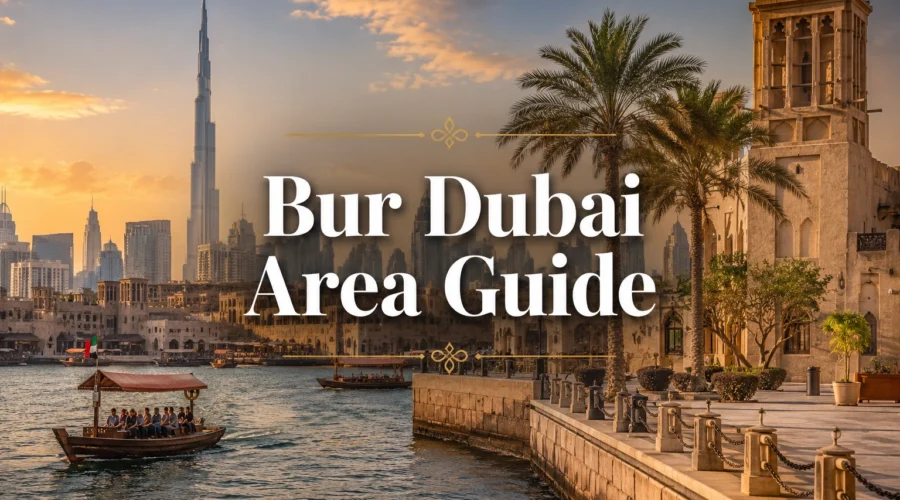
Bur Dubai is the historic western district of Dubai, sitting on the bank of Dubai Creek opposite Deira. It is one half of what locals still call Old Dubai, the original settlement from which the entire modern city grew. Bur Dubai is known for its restored heritage architecture in Al Fahidi, its traditional souks around Meena Bazaar, its museums clustered in Al Shindagha, and its dense, walkable mix of budget hotels, apartment blocks, and everyday local businesses.
Bur Dubai is best suited to travelers who want cultural depth over resort polish, families who value affordability and central location, expats who want a low-cost, well-connected base, and anyone who wants to understand what Dubai looked like before the skyline existed. It is not the right choice for visitors seeking beach resorts, nightlife districts, or brand-new high-rise living, since those experiences are better served elsewhere in the city.
Where Is Bur Dubai?
Bur Dubai occupies the western bank of Dubai Creek, directly facing Deira across the water. Its boundaries stretch from the Creek’s mouth near Al Shindagha in the north down through Al Fahidi, Al Mankhool, and Al Raffa, extending south toward Oud Metha and bordering Al Karama to the west.
Understanding Bur Dubai means understanding it as a cluster of connected sub-areas rather than a single uniform district:
- Al Fahidi: the restored heritage core, home to wind-tower architecture and museums
- Al Shindagha: the northernmost historic quarter at the Creek’s mouth, home to Dubai Heritage Village and Sheikh Saeed Al Maktoum House
- Meena Bazaar: the commercial and textile trading heart
- Al Mankhool: a mixed residential and commercial stretch closer to Sheikh Zayed Road
- Al Raffa: an older residential pocket near BurJuman
- Oud Metha and Al Karama: bordering areas with their own residential identity, often grouped with Bur Dubai in property listings
- Al Hamriya and Al Jaddaf: eastern extensions along the Creek, closer to newer development
The Al Shindagha Tunnel connects Bur Dubai directly to Deira along the northern edge, while Sheikh Zayed Road and the Dubai Metro provide the main links to the rest of the city.
If you are comparing Bur Dubai with Dubai’s modern business and residential districts, our Business Bay Area Guide explains its lifestyle, property options, connectivity, and business environment.
Why Visit Bur Dubai?
Bur Dubai’s appeal is that it compresses several distinct experiences into a compact, walkable area: heritage architecture, working traditional markets, museum-quality history, and everyday multicultural street life, all within a district smaller than most single Downtown Dubai developments.
For tourists, this means a half-day or full-day visit covers more ground per hour than almost anywhere else in the city. For families, it means walkable distances, low-cost food, and genuine cultural content rather than manufactured attractions. For couples, the Creek waterfront and evening abra crossings offer a quieter, more atmospheric alternative to the Marina or Downtown skyline. For expats and long-term residents, Bur Dubai remains one of the most affordable, centrally located, and well-connected districts in Dubai, at the cost of older buildings and busier streets.
Top Attractions in Bur Dubai
Al Fahidi Historical Neighbourhood
Al Fahidi, also known as the Bastakiya Quarter, is a restored late 19th-century district built by Persian merchant families from the town of Bastak. The area covers roughly 3.8 hectares and contains around 50 to 60 restored coral-stone and gypsum buildings, connected by narrow alleyways known locally as sikkas. In the 1980s, the neighbourhood was slated for demolition before conservation efforts intervened, and it is now a protected heritage zone housing art galleries, cultural foundations, and small cafes.
Allow 60 to 90 minutes to walk the lanes properly. Visit in the early morning or after 4pm, since the narrow alleys offer little shade at midday.
For visitors interested in Dubai’s modern attractions and luxury lifestyle, explore our Downtown Dubai Area Guide for a detailed look at the area.
Dubai Museum at Al Fahidi Fort
Housed inside Al Fahidi Fort, believed to be Dubai’s oldest surviving building dating to around 1787, Dubai Museum uses underground galleries to recreate pre-oil Dubai: pearl diving, desert life, traditional souks, and the maritime trade that built the city. A visit typically takes 45 minutes to an hour and works best as an early stop, since it gives historical context to everything else in the district.
Al Shindagha Historic District
At the northern tip of Bur Dubai, where the Creek meets the Gulf, Al Shindagha is a separate and equally important heritage cluster from Al Fahidi. It includes Dubai Heritage Village, a living museum recreating Bedouin desert and coastal life with Barasti palm-frond houses, pottery and weaving demonstrations, and a small handicrafts souk. Nearby, Sheikh Saeed Al Maktoum House, built in 1896 as the residence of the former ruler of Dubai, is now part of the Al Shindagha Museum, displaying artefacts across nine themed wings covering the Al Maktoum family, old Dubai, marine life, and historical documents. Entry to Sheikh Saeed Al Maktoum House is low-cost, generally in the range of a few dirhams for adults, though visitors should confirm current pricing on-site or through Dubai Culture’s official channels.
Al Shindagha is often skipped by first-time visitors who stop at Al Fahidi, which is a mistake, since it holds some of the most historically significant buildings in the entire city and is notably less crowded.
Meena Bazaar and the Textile Souk
Meena Bazaar is Bur Dubai’s commercial spine, a dense stretch of fabric shops, tailoring outlets, and general trading stores shaped by the district’s long-standing South Asian community. The adjoining Textile Souk is a covered market specializing in silk, cotton, and embroidered fabric. Bargaining is standard practice, and custom tailoring is a genuine local specialty, with many shops able to produce a made-to-measure garment within a day or two.
Grand Mosque and Iranian Mosque
The Grand Mosque near Al Fahidi is Dubai’s largest mosque and features the city’s tallest minaret, though its interior is generally not open to non-Muslim visitors. A short distance away, the Iranian Mosque is a smaller but visually distinctive structure covered in blue mosaic tiles, worth a photo stop even if only viewed from outside.
Hindu Temple
Located within the lanes near Meena Bazaar, the Hindu Temple, commonly referring to the Shiva and Krishna Mandir, remains an active place of worship for Dubai’s South Asian community. Visitors are generally welcome outside prayer times, with modest dress expected.
Al Seef
Al Seef is a newer waterfront development along the Bur Dubai side of the Creek, built to echo traditional architecture while offering modern restaurants, retail, and a promenade. It functions as a bridge between the historic core and a more contemporary, tourist-friendly Creek experience, and pairs naturally with a visit to Al Fahidi or an abra crossing.
BurJuman Mall
BurJuman is Bur Dubai’s main modern shopping mall, connected directly to BurJuman Metro Station. It offers air-conditioned relief and mid-range to upscale retail as a contrast to the traditional souks nearby.
Best Things to Do in Bur Dubai
Beyond visiting individual attractions, Bur Dubai rewards a few specific activities:
- Take an abra across Dubai Creek. This traditional wooden boat has ferried passengers between Bur Dubai and Deira for generations, departing from stations near the Textile Souk and near the Old Souk. The crossing costs a fraction of a dirham and takes five to ten minutes.
- Join a dhow dinner cruise. Distinct from the abra, dhow cruises are a paid evening activity along the Creek, typically including a meal and sometimes live entertainment such as Tanoura dance performances.
- Visit the Sheikh Mohammed Centre for Cultural Understanding (SMCCU). Based in Al Fahidi, SMCCU offers structured cultural sessions, including guided walking tours and hosted meals where visitors can ask questions directly about Emirati culture and Islam in an informal setting.
- Browse the Coffee Museum. A small, focused museum in Al Fahidi dedicated to the history and culture of coffee across the Arab world.
- Walk Al Fahidi Street. The district’s de facto high street, lined with shops selling clothing, shoes, jewellery, and electronics, giving a more everyday commercial contrast to the heritage lanes.
If you prefer a modern waterfront lifestyle with restaurants, leisure attractions, and high-rise residences, read our Dubai Marina Area Guide.
Bur Dubai Historical and Cultural Experience
Bur Dubai’s importance to Dubai’s heritage goes beyond any single building. It represents the physical starting point of the city’s transformation from a small trading and pearling settlement into a global hub, and it is one of the few districts where that transition is still visible in the streets themselves rather than only in a museum case.
The most meaningful way to experience this is to treat Al Fahidi, Al Shindagha, and the Creek waterfront as one continuous route rather than three separate stops. Starting in Al Fahidi gives architectural context, continuing to Al Shindagha adds the ruling family’s history and everyday Bedouin life, and finishing with an abra crossing places the visitor inside the same mode of transport that connected the two sides of the city for over a century before bridges and tunnels existed.
Families and residents looking for a more community-focused residential environment can also explore our JVC Area Guide.
Restaurants and Cafes in Bur Dubai
Bur Dubai’s dining scene reflects its demographic makeup, with a strong concentration of Indian, Pakistani, Arabic, and Iranian cuisine alongside a smaller cluster of heritage-focused cafes inside Al Fahidi.
- Indian and Pakistani cuisine is widely available throughout Meena Bazaar and Al Karama-adjacent streets, generally at budget-friendly prices, ranging from simple thali restaurants to more established sit-down venues.
- Arabic and Emirati cuisine is concentrated around Al Fahidi, where courtyard cafes serve traditional dishes in a heritage setting, often at a higher price point than the surrounding souk restaurants given the setting and experience.
- Iranian cuisine has a longstanding presence in Bur Dubai given the district’s historical Persian merchant community, with several long-running restaurants serving grilled kebabs and traditional stews.
- Family-friendly dining is easy to find throughout the district, with casual, high-turnover restaurants suited to walk-in visits rather than reservations.
- Cafes inside Al Fahidi tend to be quieter and more suited to a slower break, often set within restored courtyard buildings.
Prices, opening hours, and specific menu details vary by venue and season, so visitors should confirm current information directly with restaurants before visiting.
For professionals considering an alternative with residential towers, offices, restaurants, and strong connectivity, see our JLT Area Guide.
Shopping in Bur Dubai
Shopping in Bur Dubai splits into two distinct experiences: traditional souk trading and modern mall retail.
Meena Bazaar and the Textile Souk remain the district’s signature shopping experience, specializing in fabric, tailoring, and imported goods. Bargaining is the norm rather than the exception, and initial asking prices should generally be treated as a starting point for negotiation rather than a fixed rate.
Jewellery and gold shopping is more closely associated with Deira across the Creek, though Meena Bazaar carries a smaller selection, and the two districts are easily combined via the abra crossing.
Electronics and general goods are available along Al Fahidi Street and in nearby commercial stretches, though shoppers should be cautious of unbranded or unofficial electronics sellers.
BurJuman Mall offers the district’s main modern retail option, combining international fashion brands with a supermarket and dining court, useful for a break from the heat or for standard mall shopping rather than souvenirs.
Practical shopping advice: carry small denominations of cash for souk purchases, expect shops to open later in the morning and stay open into the evening, and treat tailoring as a genuine specialty of the area worth allowing extra time for, since made-to-measure orders typically require at least one return visit for fitting.
Hotels in Bur Dubai
Bur Dubai offers one of the widest accommodation ranges in Dubai relative to its size, spanning budget to upscale options, though it does not have ultra-luxury resort-style properties, which are concentrated elsewhere in the city.
- Budget hotels are heavily concentrated around Al Fahidi Street and Meena Bazaar, popular with backpackers and value-focused travelers due to proximity to the metro and souks.
- Mid-range hotels, including well-known names near Dubai Museum, offer a balance of location and comfort, often within walking distance of the main heritage sites.
- Upscale hotels are present in smaller numbers, typically offering rooftop dining or additional amenities while remaining more affordable than comparable properties in Downtown Dubai or the Marina.
- Serviced apartments are common throughout Al Mankhool and Al Raffa, suited to longer stays or travelers who want kitchen facilities.
- Family hotels are generally the mid-range properties near Dubai Museum and BurJuman, given their walkability and proximity to supermarkets and pharmacies.
- Business travelers are better served by hotels near BurJuman Metro Station, given quick access to Sheikh Zayed Road and DIFC.
Compared with staying in more modern districts, Bur Dubai hotels tend to offer significantly lower nightly rates and unmatched proximity to heritage attractions, at the cost of older building stock, narrower streets, and less resort-style infrastructure such as large pools or private beach access.
Living in Bur Dubai
Bur Dubai is one of Dubai’s most established residential districts, particularly popular with South Asian and Middle Eastern expat communities, and increasingly with young professionals seeking affordability and central location.
Apartment types range from older studio and one-bedroom units in low to mid-rise buildings, to larger three and four-bedroom apartments, with some family villas in the quieter pockets bordering Oud Metha. Older buildings tend to offer more spacious layouts at lower rents, while newer developments provide modern fittings, gyms, and pools at a premium.
Rental considerations: exact current rental prices vary significantly by building, apartment age, and sub-area, and change with the broader Dubai market, so any figures should be treated as approximate and verified against a current, dated source such as a licensed real estate portal or agency at the time of inquiry rather than relied upon from older guides.
Family suitability is generally good given proximity to supermarkets, clinics, and schools, though families prioritizing quiet streets and newer buildings may prefer the calmer residential pockets in Oud Metha over the busier core near Meena Bazaar.
Walkability is high within the district itself, though older sidewalks and heavier traffic on main roads such as Sheikh Khalifa Bin Zayed Street require more caution than in newer, purpose-planned communities.
Noise and traffic are more noticeable in Bur Dubai than in quieter suburban districts, particularly around Meena Bazaar and Al Fahidi Street during the day and early evening.
Parking can be limited in the older, denser parts of the district, particularly around the souks, though most residential buildings provide dedicated parking for residents.
Amenities and daily shopping are a genuine strength, with supermarkets, pharmacies, and small retail spread throughout every sub-area rather than concentrated in a single mall.
Public transportation access is excellent by Dubai standards, with multiple metro stations serving the district directly.
Community atmosphere tends to be dense, multicultural, and street-oriented, closer to how older Asian and Middle Eastern cities feel than the master-planned, gated-community model common elsewhere in Dubai.
Transportation in Bur Dubai
Bur Dubai is one of the best-connected districts in Dubai for public transport, served by the Green Line of the Dubai Metro with several stations directly within or bordering the district: BurJuman Metro Station (an interchange between the Red and Green Lines), Al Fahidi Metro Station, Al Ghubaiba Metro Station, Sharaf DG Metro Station, and ADCB Metro Station. Between them, these stations put almost every part of Bur Dubai within a short walk of the metro network.
Bus services run through Al Ghubaiba Bus Station, one of Dubai’s main bus terminals, connecting Bur Dubai to areas not directly served by the metro.
Abra crossings connect Bur Dubai to Deira from stations near the Textile Souk and the Old Souk, operating continuously and remaining the fastest way to cross the Creek on foot.
Taxis and ride-hailing apps are widely available throughout the district’s main roads.
Walking is the most practical way to explore the heritage core itself, since the narrow lanes of Al Fahidi and the souk areas are not vehicle-friendly.
Driving and parking are workable but more constrained than in newer districts, with limited on-street parking near the souks and heavier traffic during peak hours, particularly around the BurJuman and Al Mankhool junctions.
Airport connectivity is straightforward, with Bur Dubai roughly a 15 to 20 minute drive from Dubai International Airport under normal traffic conditions, and metro connections available via interchange stations for those without luggage constraints.
For most visitors, the practical rule is: use the metro for longer trips across the district or city, walk within the heritage core, and use the abra rather than a taxi to cross the Creek.
Bur Dubai for Different Types of People
Tourists get maximum cultural content per hour spent, particularly on a first visit to Dubai, but should pace visits around the heat and treat Al Fahidi and Al Shindagha as separate outings rather than one rushed loop.
Families benefit from affordability, walkability, and genuine educational content at the museums, though strollers and young children are better suited to the wider paths of Al Seef and Al Shindagha than the narrow, uneven lanes of Al Fahidi.
Couples find the Creek waterfront, sunset abra crossings, and courtyard cafes in Al Fahidi well suited to a quieter, more atmospheric alternative to Dubai’s more built-up tourist zones.
Solo travelers benefit from the district’s walkability, budget accommodation options, and the structured, low-pressure cultural sessions offered by SMCCU.
Expats considering a move should weigh Bur Dubai’s affordability and central location against older building stock and busier streets compared with newer, master-planned communities.
Long-term residents generally value the district for its daily convenience and multicultural community atmosphere, factors that matter more than they do for a short tourist stay.
Property buyers and investors should treat Bur Dubai as a value and rental-demand play rather than a luxury or capital-appreciation play, given its established, older building stock and comparatively affordable price point relative to Downtown Dubai or the Marina.
Business travelers are best served by staying near BurJuman, given direct metro access to Sheikh Zayed Road and DIFC.
Pros and Cons of Bur Dubai
Pros:
- Central location with strong metro and bus connectivity
- Significant cultural and historical density unmatched elsewhere in Dubai
- Affordable dining, shopping, and accommodation relative to newer districts
- Walkable heritage core
- Genuine multicultural, non-manufactured local atmosphere
Cons:
- Older building stock compared with newer Dubai districts
- Heavier traffic and street noise, particularly around Meena Bazaar
- Limited on-street parking near the souks
- Narrow lanes in Al Fahidi that are less accessible for strollers or mobility aids
- Fewer resort-style amenities such as large pools, private beach access, or new-build finishes
Bur Dubai vs Nearby Areas
Bur Dubai vs Deira: Deira, across the Creek, leans toward large-scale trading, anchored by the Gold Souk and Spice Souk, while Bur Dubai carries more of the residential heritage architecture, centered on Al Fahidi. The two are best experienced together via an abra crossing rather than chosen as either-or.
Bur Dubai vs Al Karama: Al Karama, bordering Bur Dubai to the south, is more purely residential and commercial, known for affordable shopping and dining but with far less heritage architecture or tourist infrastructure. Bur Dubai suits visitors seeking culture and history, while Al Karama suits residents and value-focused day-to-day shopping.
Bur Dubai vs Downtown Dubai: Downtown Dubai offers the Burj Khalifa, Dubai Mall, and modern skyline views, at a significantly higher cost of accommodation and dining. Bur Dubai offers heritage depth and affordability instead, roughly 15 to 20 minutes away by taxi or a short metro ride.
Bur Dubai vs Jumeirah: Jumeirah is defined by beach access and residential villas along the coast, an entirely different experience from Bur Dubai’s dense, inland heritage core. Travelers wanting both should treat them as separate day plans rather than combine them.
Best Time to Visit Bur Dubai
The most comfortable months to explore Bur Dubai on foot are November through March, when daytime temperatures are manageable for extended walking through the heritage lanes and souks. Between June and September, outdoor walking becomes genuinely difficult during midday hours, and visits should be planned for early morning before 10am or from late afternoon into the evening.
During Ramadan, opening hours for shops, restaurants, and attractions shift, with many venues operating reduced daytime hours and busier evening hours after iftar, so visitors during this period should confirm timings in advance rather than assume standard hours apply.
Weekends, particularly Friday and Saturday evenings, bring larger crowds to Meena Bazaar and the Textile Souk, while weekday mornings offer a quieter, more comfortable pace for exploring Al Fahidi and the museums.
Hidden Gems and Local Tips
- Al Shindagha over Al Fahidi for fewer crowds. Most first-time visitors stop at Al Fahidi and skip Al Shindagha entirely, despite it holding some of the city’s most historically significant buildings, including Sheikh Saeed Al Maktoum House.
- Time the abra for sunset, not because it’s a secret, but because the light on the water and the call to prayer echoing from the Creek-side mosques genuinely change the experience compared with a midday crossing.
- A common mistake is trying to cover Al Fahidi, Al Shindagha, and Deira’s souks in a single afternoon. The distances are short, but the heat and the sheer density of things to see make this rushed and exhausting rather than enjoyable.
- Tailoring takes more than one visit. Visitors expecting same-day custom garments from Meena Bazaar tailors should instead plan for at least one fitting appointment, typically within 24 to 48 hours of the initial order.
- SMCCU sessions require advance booking in practice, since walk-in availability is limited and the cultural meal sessions are one of the more genuinely informative experiences in the district rather than a generic tourist add-on.
One-Day Bur Dubai Itinerary
- Morning: Start at Al Fahidi Metro Station and walk into Al Fahidi Historical Neighbourhood before the heat builds.
- Late morning: Visit Dubai Museum at Al Fahidi Fort to establish historical context.
- Midday: Take a taxi or walk north toward Al Shindagha to visit Dubai Heritage Village and Sheikh Saeed Al Maktoum House, pausing for a break at an air-conditioned cafe if needed.
- Early afternoon: Return toward Meena Bazaar and the Textile Souk for shopping and lunch.
- Late afternoon: Walk or taxi to Al Seef for a break along the modern waterfront promenade.
- Evening: Take an abra across Dubai Creek timed for sunset, continuing into Deira’s Gold Souk and Spice Souk to close the day.
This sequence takes six to eight hours at a comfortable pace, including breaks, and can be shortened to a half-day by dropping either Al Shindagha or the Deira extension.
Local Businesses and Essential Services
Bur Dubai functions as a genuine residential district, not only a tourist zone, and is well served by everyday services spread throughout its sub-areas rather than concentrated in a single complex.
- Supermarkets, including international and regional chains, are present throughout Al Mankhool, Al Raffa, and Meena Bazaar
- Pharmacies are widely available along main commercial streets
- Clinics and hospitals serve the district’s dense residential population, with several private clinics concentrated near Al Mankhool and Oud Metha
- Banks and ATMs are common along Al Fahidi Street and near BurJuman
- Schools in the wider Bur Dubai and Oud Metha area serve the district’s family population, though specific school options should be verified directly given frequent changes in capacity and curriculum offerings
- Salons and everyday personal care services are dense throughout the residential pockets
- Car services and fitness centres are available, particularly in newer buildings in Al Mankhool
For authoritative, current information on public transport routes and schedules, Dubai’s Roads and Transport Authority (RTA) publishes official metro and bus network details. For verified information on museum hours, entry fees, and cultural site access across Al Fahidi and Al Shindagha, Dubai’s Department of Economy and Tourism and Dubai Culture and Arts Authority are the appropriate official sources to confirm current details before visiting.
Frequently Asked Questions
What is Bur Dubai known for?
Bur Dubai is known for being the historic core of Old Dubai, home to the restored Al Fahidi Historical Neighbourhood, Dubai Museum, Al Shindagha’s heritage sites, and the traditional souks around Meena Bazaar.
Is Bur Dubai a good area to stay in Dubai?
Yes, particularly for travelers who value central location, affordability, and proximity to heritage attractions over resort-style amenities. It offers strong metro connectivity and a wide range of hotel budgets.
Is Bur Dubai good for families?
Yes, largely due to affordability, walkability, and genuine educational content at its museums, though families with strollers may find the narrow lanes of Al Fahidi more challenging than the wider paths of Al Seef or Al Shindagha.
What are the best things to do in Bur Dubai?
The top activities are walking Al Fahidi Historical Neighbourhood, visiting Dubai Museum at Al Fahidi Fort, exploring Al Shindagha’s Heritage Village and Sheikh Saeed Al Maktoum House, shopping in Meena Bazaar, and crossing Dubai Creek by abra.
Is Bur Dubai expensive?
No, Bur Dubai is generally one of Dubai’s more affordable districts for dining, shopping, and accommodation compared with Downtown Dubai or Dubai Marina.
What is the best place to visit in Bur Dubai?
Al Fahidi Historical Neighbourhood is the most commonly recommended starting point, given its concentration of restored architecture and proximity to Dubai Museum, though Al Shindagha offers comparable historical significance with fewer crowds.
How do I get around Bur Dubai?
The Dubai Metro Green Line, with stations including BurJuman, Al Fahidi, Al Ghubaiba, Sharaf DG, and ADCB, covers most of the district. Walking is best within the heritage core, and the abra is the fastest way to cross the Creek to Deira.
Is Bur Dubai close to Dubai Creek?
Yes, Bur Dubai sits directly on the western bank of Dubai Creek, with the Creek forming its eastern and northern boundary.
Which metro stations serve Bur Dubai?
BurJuman, Al Fahidi, Al Ghubaiba, Sharaf DG, and ADCB metro stations all serve different parts of Bur Dubai on the Green Line, with BurJuman also connecting to the Red Line.
Is Bur Dubai a good place to live?
Yes, for those prioritizing affordability, central location, and access to daily amenities, though it involves older building stock and busier streets compared with newer, master-planned Dubai communities.
What is Bur Dubai famous for?
Bur Dubai is famous for being the historic heart of Dubai, home to Al Fahidi’s wind-tower architecture, Dubai Museum, and the traditional Meena Bazaar textile souks.
Is Bur Dubai safe for tourists?
Bur Dubai is a well-populated, heavily trafficked district with a strong daytime and evening presence of residents, shoppers, and tourists, consistent with Dubai’s generally low crime rate, though visitors should take normal city precautions with belongings in crowded souk areas.
How far is Bur Dubai from Dubai Airport?
Bur Dubai is roughly a 15 to 20 minute drive from Dubai International Airport under normal traffic conditions.
Is Bur Dubai better than Deira?
Neither is objectively better; they serve different purposes. Bur Dubai offers more residential heritage architecture and museums, while Deira offers the Gold Souk and Spice Souk trading experience. Most visitors benefit from combining both via the abra crossing.
How many days do you need in Bur Dubai?
A focused visit to the main attractions takes one full day or two relaxed half-days, allowing separate time for Al Fahidi and Al Shindagha rather than combining them into a single rushed outing.